


-RATED BY




Built in Canada
All Ecoline windows and doors are built in Ontario, Canada
- Top-of-the-line machinery (Forel, Gracco, Bottero) to produce the best products
- Over 60,000 sq. ft manufacturing plant
- Energy Star-rated and NAFS-11-tested
- Manufactured for local weather conditions
5 Best Basement Window Blinds for Privacy, Moisture and Light
Aug 12, 2026
11 min read
741
Basement windows can be tricky. If you leave them uncovered, people outside might see right in. But if you cover them too much, you lose the little natural light you have. Cold glass, condensation, and unusual openings make picking the right basement window blind even harder.
At Ecoline, we usually recommend homeowners looking at roller shades, cellular shades, faux wood blinds, zebra shades, and solar shades for basement windows. But to make the right choice, first you need to double-check how you use your basement, how much privacy you want, and whether the covering works with your window.


What Makes Basement Window Blinds Different?
Basement windows are different from those upstairs. They are usually smaller, closer to the ground, and in rooms with less daylight. A blind that works well in a bedroom or living room might make a basement feel darker or cause issues with cold windows.
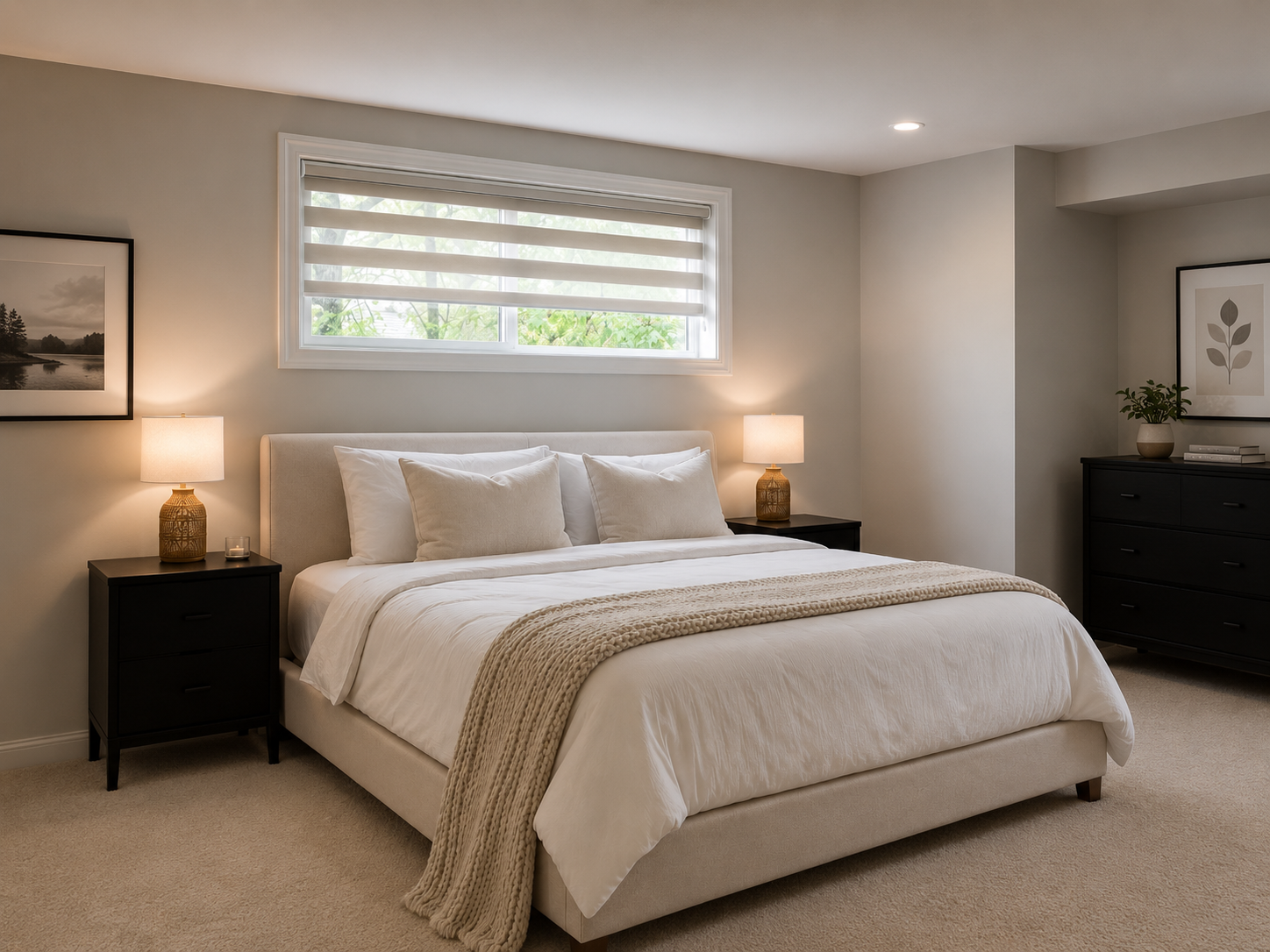
Privacy is often the main concern. Basement windows near sidewalks, driveways, or yards can be right at eye level from outside. The challenge is to cover the window enough for privacy without blocking it all day.
Moisture is another big factor. Windows in this area of the home often have cold glass, so condensation is more likely if the air is humid, since closed blinds can trap air and cause more condensation. And it’s usually recommended to keep humidity between 30% and 50% and leave window coverings open if you see condensation.
Size and how the window works are also important. Basement windows are often short, wide, or close to the ceiling, so there may not be much space for hardware or rolled-up fabric. That’s why, before picking a specific window covering, check:
- how the sash opens;
- whether there is a crank or handle in the mounting area;
- the available inside-mount depth;
- how much glass will remain uncovered when the blind is raised.
In a finished basement, especially a bedroom, make sure the covering is easy to move aside and never blocks a window that could be used as an emergency exit.
Expert tip: If you often see water on the glass or sill, fix the moisture problem first. Some custom blinds handle basement conditions better, but they cannot solve high humidity, poor airflow, or window issues that cause ongoing condensation.
Best Window Blinds for Basements: Side-by-Side Comparison
There is no one-size-fits-all solution when it comes to blinds and shades in a basement. A small north-facing window in a cold basement needs something different than a big west-facing walkout window or a laundry room window that gets condensation every winter.
| Style | Use case | Light control | Privacy | Energy-efficiency | Moisture-tolerance |
| Roller shades | Typical finished basement | Very good, depending on fabric opacity | Good to high | Low | Good especially for models with PVC components |
| Cellular shades | Cold basement bedrooms and living areas | Good | High | Highest | Moderate |
| Zebra blinds | Laundry rooms, bathrooms and utility spaces | Excellent through adjustable slats | High | Low | Very good |
| Faux-wood blinds | Offices and living areas needing flexible privacy | Excellent | Adjustable | Low to moderate | Moderate |
| Solar shades | Sunny walkout basements and larger windows | Excellent for glare control | Mainly daytime | Low to moderate | Good |
Here’s the list of the top 5 most popular window treatments to consider for your basement in detail:
1. Basement Roller Shades: Best for a Typical Basement
For a typical basement window, especially if it’s short and high up, we usually suggest roller shades first. They take up little space, almost disappear when raised, and you can choose different fabric opacities without changing how they work.
This is even more important in basements. If you only have two small windows, a bulky blind that covers part of the glass can make the room much darker.
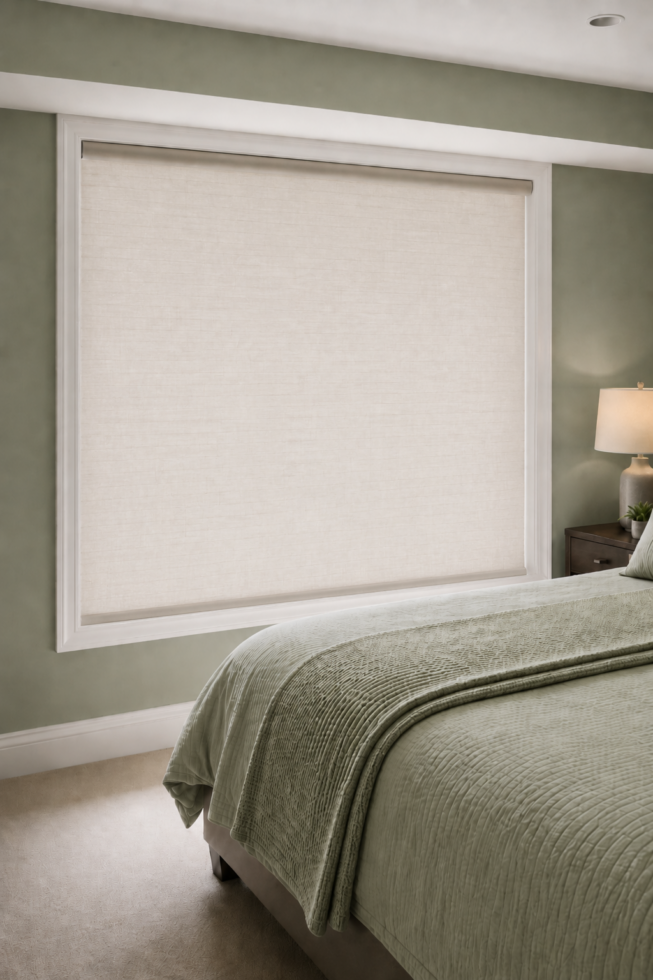
But the fabric you choose here matters most. Light-filtering fabrics let in soft daylight and block direct views, keeping the room brighter. Semi-opaque fabrics give more privacy, while blackout ones darken the room.
For example, in a finished basement family room with two small windows facing the backyard, using blackout shades for privacy might mean you need to turn on lights during the day. A light-filtering roller usually works better because it gives privacy but still lets in daylight.
That’s why roller shades are our top pick. They may not insulate the best or control light perfectly, but they handle most basement needs without being bulky.
2. Basement Cellular Shades: Best for Energy-Efficiency
If keeping heat in is your main concern, cellular shades are a better choice than rollers. They come with a pleated fabric that forms honeycomb-shaped pockets, trapping air and adding insulation between the room and the glass. They are one of the few window coverings with strong data showing they improve thermal performance.
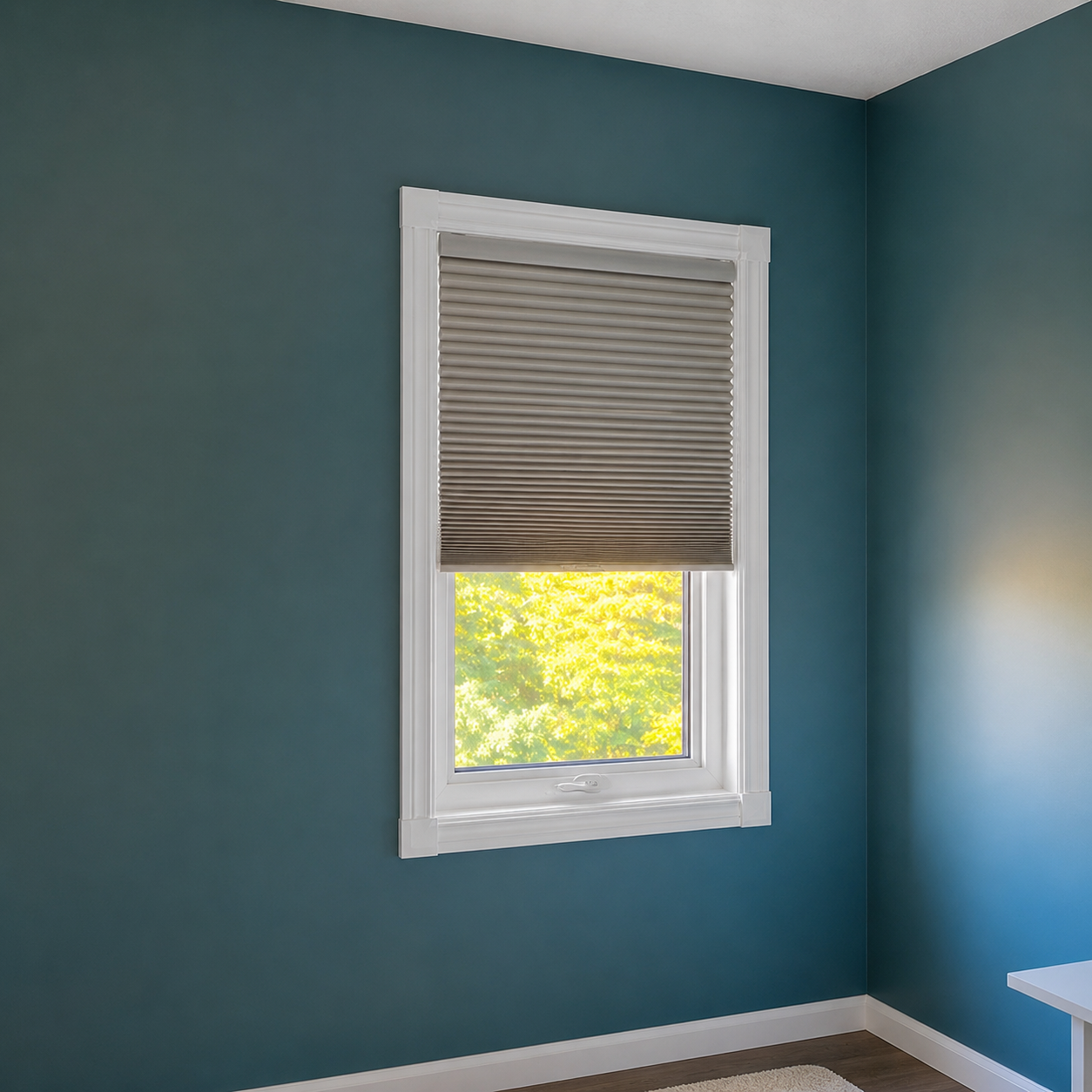
The research reveals that properly installed cellular shades can reduce heat loss through windows by 17% – 36% or more under suitable conditions. Controlled testing has also shown meaningful reductions in heating and cooling loads compared with conventional blinds, although performance changes with the glazing, shade construction, fit, climate and how often the shade is actually closed.
This makes cellular shades especially useful in Canadian basements, where comfort issues often go beyond just the window since basements can lose about 25% of a home’s heat, mostly through foundations, leaks, and openings. While cellular shades can’t fix an uninsulated wall or a leaky window, they do help reduce cold near the glass.
If your basement bedroom feels cold at night, cellular shades are your go-to option. But for a damp, unfinished basement, we suggest looking at other options.
3. Basement Faux Wood Blinds: Best for Moisture Control
If you care more about handling humidity, splashes, or easy cleaning than insulation, faux wood blinds are a practical choice.
Unlike real wood, which can react poorly to repeated moisture exposure, many faux wood blinds use PVC or polymer-composite slats engineered specifically for humid rooms. Current systems commonly use approximately 2-inch to 2½-inch slats, which are well-suited for bathrooms, kitchens and laundry areas because of their resistance to moisture, warping, cracking and peeling.
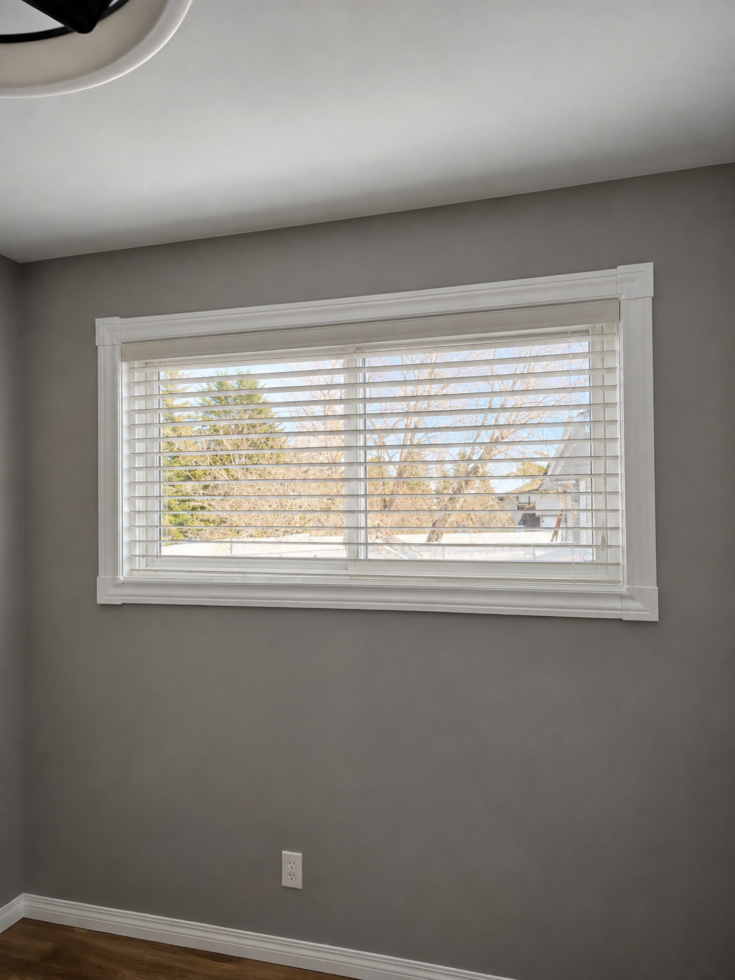
This makes them a good choice for basement laundry areas or bathrooms, where fabric shades would often be near humid air. Faux wood blinds also let you adjust the angle of the slats, so you can control the light without opening the window fully. On a street-facing basement window, tilting the slats up can block views from outside but still let in daylight.
However, we don’t usually recommend faux wood blinds for every basement. The headrail and stacked slats stay visible when the blind is up, which can be a problem on small windows. They also don’t insulate as well as cellular shades.
4. Basement Zebra Shades: Best for Privacy Control
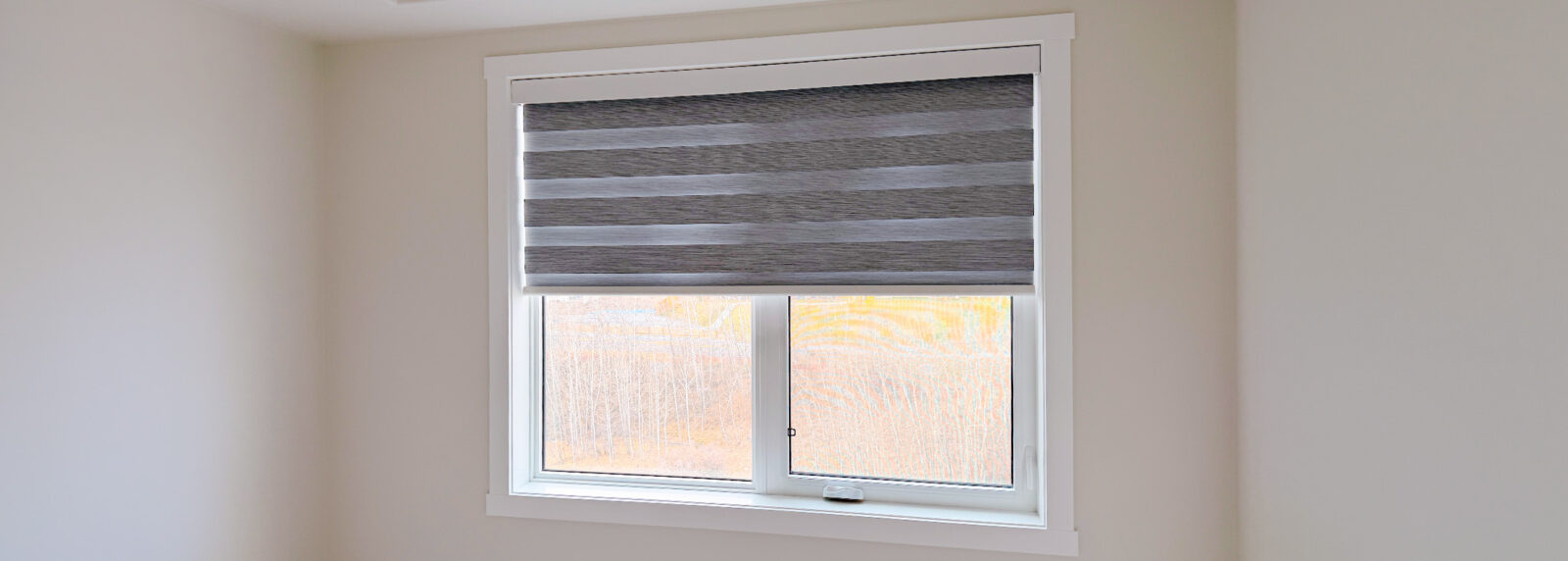
Zebra shades are a good option in finished basements because they offer partial privacy. Unlike regular rollers or cellular shades, you don’t have to choose between fully open or fully closed.
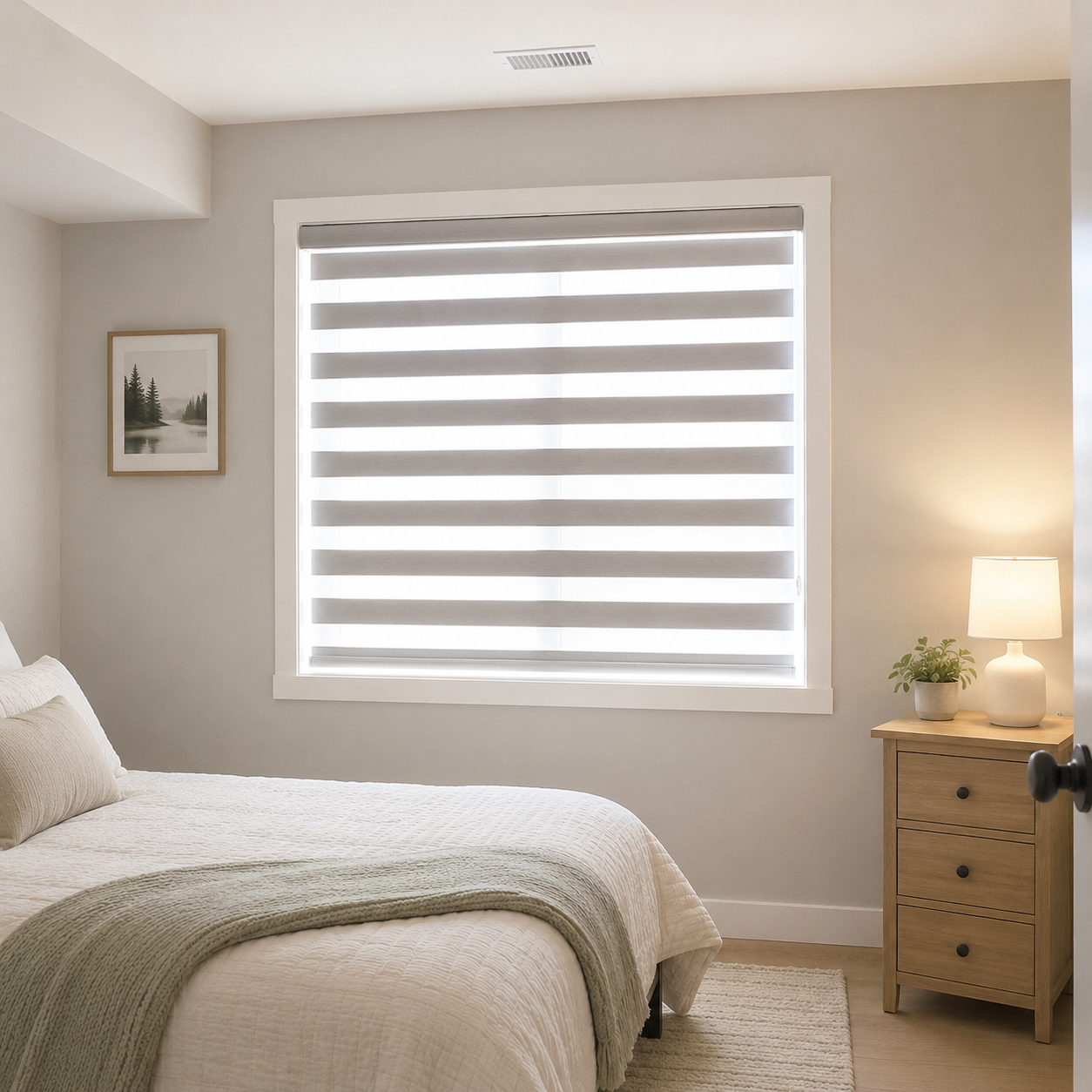
These shades have alternating sheer and opaque bands on two layers of fabric. By moving one layer, you can line up the sheer bands for more daylight or overlap the opaque bands for more privacy.
This control is helpful for a basement office facing a driveway or sidewalk. During the day, you can set the bands to block views but still let in light. Later, you can close them more for extra privacy.
There are two things homeowners sometimes overlook.
- First, the sheer position should be treated mainly as daytime privacy, not complete privacy. After sunset, a brightly illuminated basement is easier to see into from a dark exterior.
- Second, zebra shades have two fabric layers and a cassette or roller. If your window frame is shallow or has a crank, you’ll need to check if the shade will fit. Sometimes, an outside mount works better, but it will cover more of the wall and trim.
So, zebra shades aren’t just a better version of rollers. But they work exceptionally well if you want to have ultimate control over privacy in your basement.
5. Basement Solar Shades: Best for Large, Sunny Windows
Solar shades are on the list since they solve a specific problem – glare regulation. For small basement windows, privacy and daylight matter more than glare. But for a walkout basement with big south- or west-facing windows, glare can be a bigger issue.
Solar fabric is rated by its openness factor, which is the amount of open space in the weave. Common options are 1%, 3%, 5%, and 10%. Lower numbers mean a tighter weave for better glare and UV control, while higher numbers let in more light and allow you to see outside.
The difference in performance can be big. Solar fabrics with 1% to 5% openness can block about 95% to 99% of UV rays, depending on colour and construction. How much visible light comes through depends on the fabric’s colour and weave, so picking “5% openness” doesn’t guarantee a certain brightness.
For example, if your walkout basement is a home office with a west-facing patio door and window, you might get a lot of glare in the afternoon. Closing an opaque roller block can cut the glare but also block the view and daylight. A 3% or 5% solar shade can cut down the glare while still letting you see outside.
Privacy is the trade-off. Solar shades work best during the day when it’s brighter outside than inside. At night, lights inside make it easier for people to see in. They’re great for large walkout windows, but not needed for most small basement windows.
Light-Filtering or Blackout Basement Shades?
After you pick a basement window blind style, the next step is choosing how much light the fabric lets through. Here, this choice matters more than you might think, since even a little natural light can change how the whole room feels.
For most family rooms, home offices, and living spaces, light-filtering fabric is usually best. It softens daylight and blocks direct views, but doesn’t cut the room off from outside. This is especially helpful when it comes to small blinds for basement windows, since blackout fabric can make you rely on artificial light during the day.
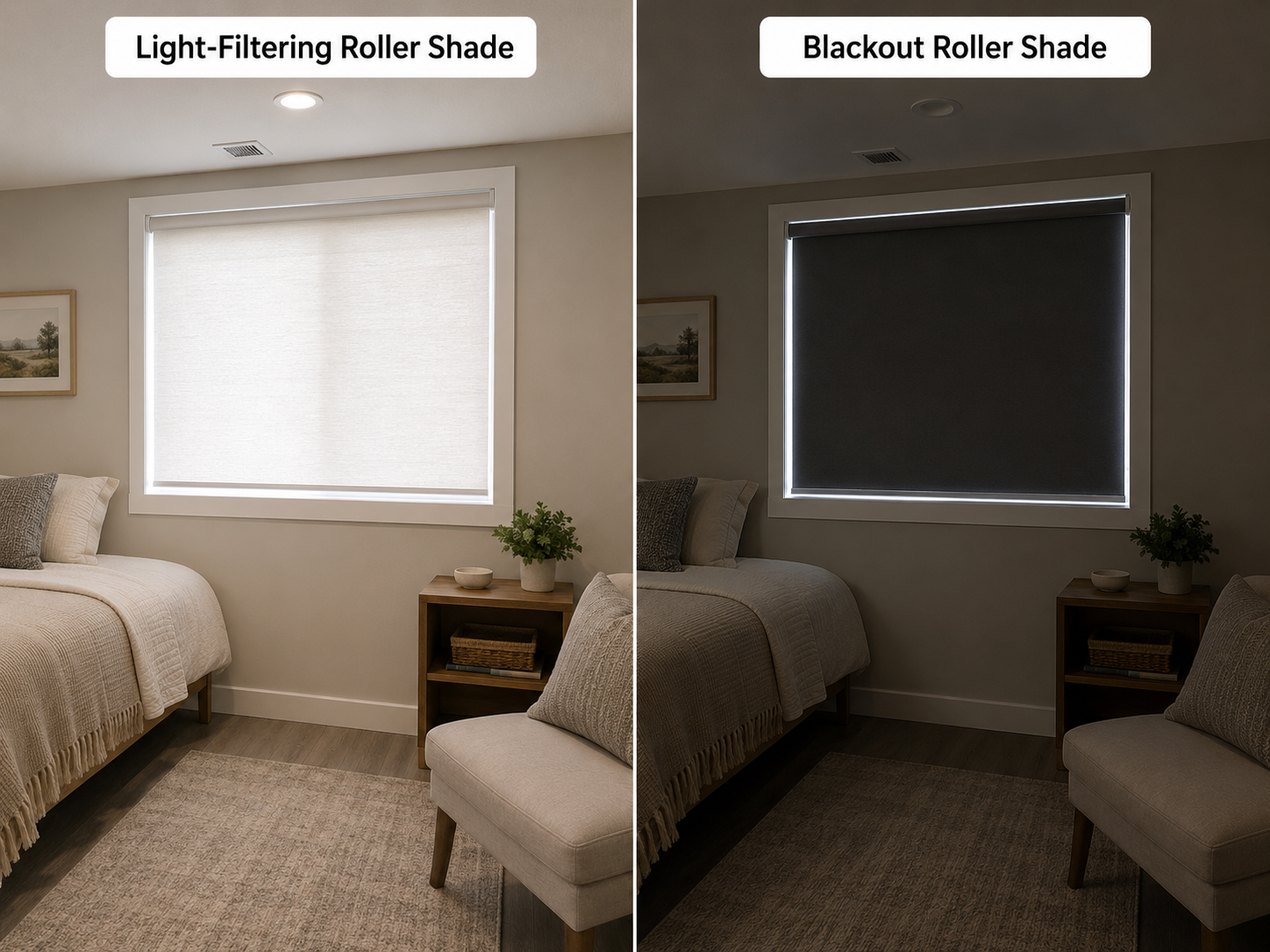
Basement bedrooms are different. Blackout fabric is better for sleeping areas, home theatres, or rooms with strong sunlight and glare. In Canada, blackout shades are often used in bedrooms and media rooms, while light-filtering fabrics are suggested for spaces where you want privacy but still need daylight.
A simple rule: match the fabric’s opacity to how you use the room:
- Family room or playroom: light filtering usually preserves the most useful daylight.
- Home office: light filtering or zebra fabric works well unless glare is severe.
- Bedroom or theatre: blackout is normally worth the loss of daylight.
- Walkout basement: solar fabric can control glare, but add a separate privacy treatment if the room is used after dark.
A common mistake is picking blackout fabric just because a basement window feels exposed. Often, the better choice is a well-chosen light-filtering fabric that gives privacy without making the basement too dark.
1750 Coast Meridian Rd #102,
Port Coquitlam, BC V3C 6R8
100, 17866 106A Avenue,
Edmonton, AB, Canada,
T5S 1V3
3307 Dunmore Rd SE #12,
Medicine Hat, AB,
Canada, T1B 3R2
2081 Merivale Rd #201, Ottawa, ON, Canada, K2G 1G9
by appointment only
108, 55 Akerley Blvd, Dartmouth,
NS, Canada, ВЗВ 1M3